


FY 2027 H-1B Cap Registration Opened March 4, 2026

Apr 22
4 min read
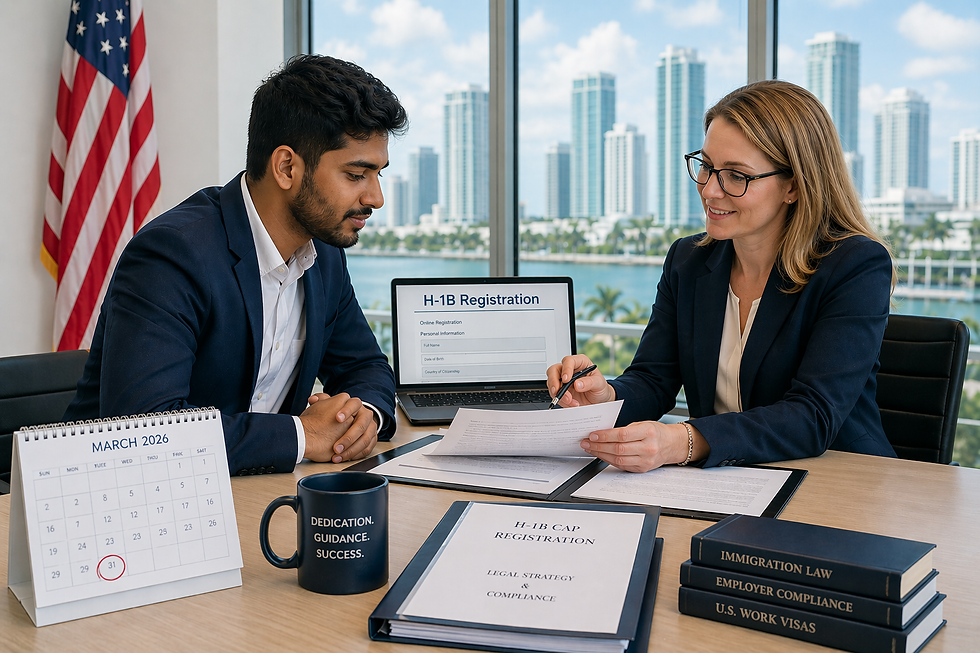
Each year, thousands of U.S. employers and foreign professionals closely monitor one key event in the immigration calendar: the opening of the H-1B cap registration period. For Fiscal Year (FY) 2027, the registration window officially opens March 4, 2026. Understanding the H-1B registration process, the associated fees, and recent policy developments is essential for employers and foreign workers planning to pursue employment in the United States.
H-1B Cap Registration for FY 2027: Key Dates, Fees, and Process
What Is the H-1B Visa?
The H-1B visa is a nonimmigrant visa that allows U.S. employers to hire foreign professionals in specialty occupations. These are positions that typically require at least a bachelor’s degree or higher in a specific field.
Common industries that rely on H-1B professionals include:
Technology
Engineering
Finance
Healthcare
Scientific research
Each fiscal year, Congress sets a limit on the number of new H-1B visas issued under the annual cap:
65,000 visas under the regular cap, and
20,000 additional visas for individuals who hold a U.S. master’s degree or higher.
Because demand for H-1B visas usually exceeds the available numbers, U.S. Citizenship and Immigration Services (USCIS) uses a selection process to determine which registrations can move forward to the petition stage.
FY 2027 Registration Timeline
For the FY 2027 H-1B cap season:
Registration opens: March 4, 2026
Registration closes: March 28, 2026
During this period, employers or their attorneys submit an electronic registration for each foreign worker they intend to sponsor. The registration stage only requires basic information about the employer and the beneficiary. Supporting documentation is not required at this stage.
Registration Fee: When Is It Paid?
At the time of registration, the employer must pay a $10 non-refundable registration fee for each beneficiary submitted into the H-1B selection system. This fee is paid during the online registration process through the employer’s USCIS account. If the registration is not selected, the process ends for that fiscal year.
What Happens If the Registration Is Selected?
If the registration is selected, the employer will receive a selection notice through the USCIS online system. At that point, the employer can move forward with filing the full H-1B petition (Form I-129).
The employer typically has 90 days from the selection notice to submit the complete petition package.
This stage requires significantly more documentation, including:
Evidence of the worker’s qualifications
Proof that the position qualifies as a specialty occupation
Labor Condition Application (LCA) approval
Employer information and wage documentation
Petition Filing Fees
The majority of H-1B government filing fees are due when the full petition is filed, not during registration.
These may include:
Form I-129 filing fee
ACWIA training fee
Fraud prevention fee
Optional premium processing fee
Because these costs can total several thousand dollars, employers should plan ahead before submitting registrations.
The New $100,000 H-1B Petition Fee
Recent policy developments have introduced a $100,000 fee for certain H-1B petitions.
This fee generally applies when:
An employer files a new H-1B petition for a worker located outside the United States, and
The petition is filed on or after September 21, 2025.
If the fee applies, it must be paid before the H-1B petition is submitted, and proof of payment must accompany the petition filing.
However, the fee does not apply to many common H-1B situations, including:
Workers already in the United States changing status to H-1B (such as F-1 students on OPT)
H-1B extensions
H-1B amendments or transfers
Questions About H-1B Workers in Florida
Some employers have asked whether Florida has restricted the employment of H-1B visa holders. Currently, H-1B visas are governed by federal immigration law, and individual states do not have the authority to prohibit employers from hiring workers who hold valid H-1B status. However, Florida has implemented employment verification requirements that require many employers to use E-Verify to confirm employees’ work authorization.
These requirements do not prevent employers from hiring H-1B workers but do require compliance with verification procedures.
Tips for Employers
Because the H-1B process is highly competitive, employers should prepare early to avoid delays or mistakes.
Important steps include:
Confirm that the job qualifies as a specialty occupation
Ensure all registration information is accurate and complete
Avoid submitting duplicate registrations for the same worker
Prepare documentation for the petition stage in advance
Consult with an immigration attorney when necessary
Careful preparation can help employers avoid costly errors and improve the chances of a successful petition.
Advice for Foreign Professionals
Foreign professionals hoping to obtain H-1B status should:
Communicate early with potential employers
Confirm that their education and job duties meet specialty occupation requirements
Understand that selection in the registration process does not guarantee visa approval
The final decision depends on USCIS review of the full petition and the applicant’s eligibility.
Why the H-1B Program Matters
The H-1B visa remains one of the most important pathways for skilled professionals to work in the United States. Every year, hundreds of thousands of foreign professionals compete for a limited number of available visas. With strict deadlines, evolving regulations, and significant filing fees, understanding the H-1B process is critical for both employers and international workers.
Working with experienced legal counsel can help ensure that registrations and petitions are prepared correctly and submitted on time.
Patricia Elizee is the Managing Partner of Elizee Law Firm, located at 1110 Brickell Avenue, Suite 315, Miami, Florida 33131. Founded in 2012, the firm represents clients in both immigration and family law matters and is known for its compassionate, client-focused, and results-driven approach. Ms. Elizee earned her Juris Doctor from the University of Miami School of Law and her Master of Laws (LL.M.) from the University of Washington School of Law.


Comments